Less Is More: The Ginza Philosophy of Dressing That American Wardrobes Have Been Missing
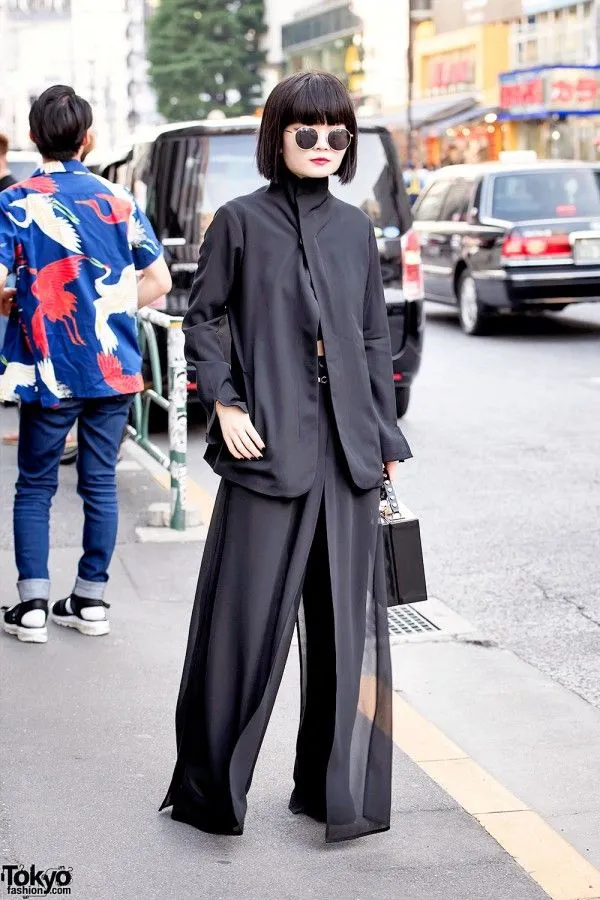
Photo: minimalist Japanese fashion layering silk cashmere Tokyo Ginza street style elegant neutral tones, via i.pinimg.com
There is a particular kind of confidence that requires no announcement. Walk through Ginza on a Tuesday afternoon — past the immaculate storefronts, the unhurried shoppers, the architecture that seems to breathe precision — and you will witness it in motion. A woman in a pale oyster-colored coat layered over a silk blouse, a single sculptural cuff at her wrist, nothing more. A man in dove-gray trousers and a structured linen overshirt, every seam deliberate. No logos. No excess. Only an absolute certainty of purpose.
This is the Ginza aesthetic — and for American fashion lovers accustomed to the exuberant, logo-forward energy of Fifth Avenue or Rodeo Drive, it can feel like encountering an entirely different language. One that, once learned, is impossible to forget.
The Architecture of Restraint
To understand how Ginza shaped its distinctive approach to dressing, one must first understand the district itself. Ginza — derived from the Japanese word for "silver mint" — has served as Tokyo's most refined commercial corridor since the Meiji era. Its evolution from a hub of Western modernization to a sanctuary of curated Japanese luxury mirrors, in many ways, the broader arc of Japanese design philosophy: absorb, refine, distill.
The buildings that line Chuo-dori Avenue are themselves a study in considered layering. Flagship stores by architects such as Toyo Ito and Jun Aoki favor translucent facades, perforated screens, and materials that shift in quality depending on the angle of light. Nothing is decorative for decoration's sake. Every element earns its presence.
This architectural sensibility has, over generations, seeped into the way Ginza residents and shoppers dress. The garment, like the building, must justify every layer it carries.
Fabric First: The Foundation of Ginza Layering
Where American layering often begins with color or pattern — a bold plaid over a graphic tee, a printed scarf atop a patterned blouse — Ginza layering begins with fabric. Specifically, with the relationship between fabrics.
The guiding principle is tactile contrast over visual contrast. A weightless organza shell beneath a double-faced cashmere coat. A ribbed cotton turtleneck under a raw-edged silk blazer. The eye may not immediately register the difference, but the body does — and so does the discerning observer who leans in.
Japanese textile culture, which encompasses centuries of silk weaving, indigo dyeing, and precision tailoring traditions rooted in both kimono craft and Western suiting, provides an extraordinary foundation for this approach. Fabrics in Ginza boutiques are selected not merely for their appearance but for their behavior: how they drape, how they respond to movement, how they age.
For American shoppers looking to adopt this philosophy, the first step is a radical reorientation of priorities. Before asking Does this look good together?, ask Does this feel considered together?
The Rule of Considered Accessories
Perhaps nowhere is the divergence between Ginza elegance and Western maximalism more apparent than in the matter of accessories. The Ginza approach does not prohibit adornment — it demands that each piece justify its place.
Where a New York outfit might layer necklaces, stack bracelets, and add a statement bag to a statement shoe, the Ginza sensibility selects one object of genuine significance and allows it to breathe. A handcrafted ceramic bangle. A bag in a leather so fine it needs no hardware to command attention. A single silk scarf — not draped loosely, but folded with the precision of origami and tucked into a collar with geometric intention.
This is not minimalism born of austerity. It is minimalism born of deep respect for the objects themselves. Each piece, in the Ginza philosophy, is allowed to be fully itself.
Translating Ginza into an American Context
Adopting this aesthetic does not require a complete wardrobe overhaul — nor does it require abandoning the dynamism that makes American personal style so compelling. What it requires is a shift in editorial thinking: treating your outfit as a composition rather than a collection.
Start with a tonal palette. Ginza layering rarely relies on contrast colors. Instead, it builds within a narrow range — ivory to ecru, slate to charcoal, blush to terracotta — creating depth through texture rather than hue. Choose two or three tones that sit within the same family and layer from there.
Invest in transitional pieces. The most powerful items in a Ginza-inspired wardrobe are those that exist between categories: the jacket that is almost a coat, the shirt that is almost a blouse, the skirt that reads as both structured and fluid. These transitional garments are the architecture of the outfit — they hold the layers together without declaring themselves.
Edit before you leave the house. The most practical piece of Ginza wisdom may also be the most counterintuitive for American dressers: remove one thing before you walk out the door. Not because less is inherently better, but because that final edit forces you to decide what truly matters in the composition you have built.
Prioritize drape over fit. American fashion has long celebrated the body-conscious silhouette — the fitted blazer, the tailored trouser. Ginza layering often moves in the opposite direction, privileging garments that fall from the shoulder or gather at the waist with intention, creating space between fabric and body. This space is not imprecision. It is elegance in motion.
Quality as the Ultimate Statement
At the heart of the Ginza layering philosophy lies a conviction that quality — true, uncompromising quality — is the only luxury that cannot be imitated. A coat in the finest boiled wool does not need embellishment. A blouse in hand-washed silk speaks for itself. When each layer is selected for the integrity of its material and the skill of its construction, the outfit becomes its own argument.
This is perhaps the most profound lesson Ginza offers the American fashion consumer: that the most sophisticated statement a wardrobe can make is one of absolute confidence in what it has chosen not to include.
At Folli Follie Ginza, this philosophy is not merely an aesthetic position — it is the foundation upon which every collection, every accessory, every carefully curated piece is built. Tokyo elegance does not shout. It simply endures.