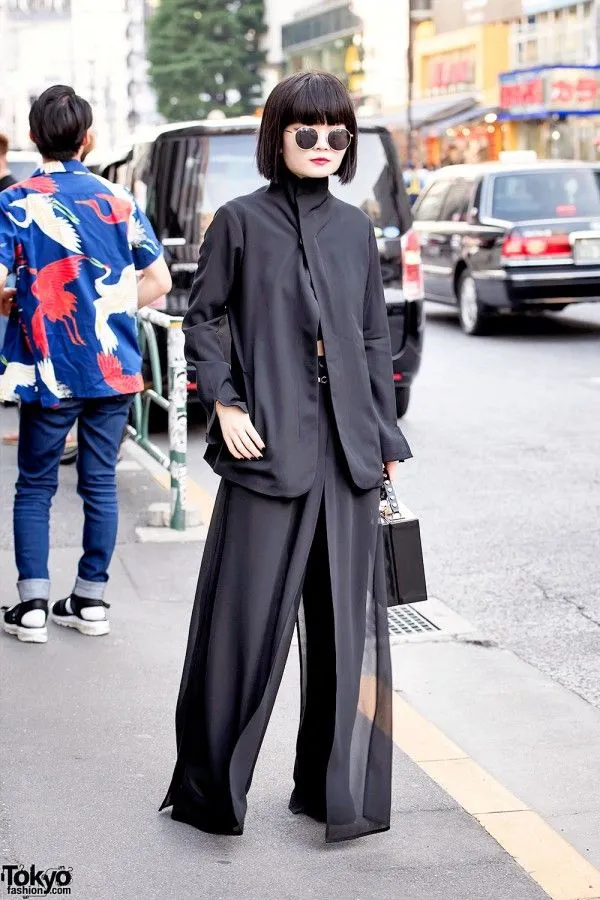
The Tokyo Effect: Why America's Most Discerning Fashion Voices Are Turning to Japan's Hidden Luxury Designers
For the better part of three decades, the geography of American luxury fashion consciousness was relatively fixed. Paris anchored couture. Milan owned leather goods. New York held sportswear and power dressing. Tokyo, while admired from a distance, occupied a category that felt more conceptual than commercial — avant-garde, cerebral, fascinating but not quite accessible.
That geography is being redrawn.
In editorial offices from Manhattan's West Village to Beverly Hills, a quiet but unmistakable obsession has taken hold. Fashion directors are rerouting their pre-season scouting trips to include Ginza. Stylists are sourcing pieces from Japanese designers whose names don't yet appear in Vogue's alphabet of approved labels. And the consumers who follow these tastemakers — affluent, educated, deeply skeptical of anything that smells like mass-market aspiration — are paying close attention.
The question worth asking is not simply what they are finding. It is why now.
The Collapse of the Legacy Luxury Consensus
To understand the current moment, it helps to understand what preceded it. For much of the 2010s, luxury fashion in the United States was defined by a relatively narrow set of European houses — brands whose heritage provided cultural permission for their price points and whose logo visibility served as a form of social currency.
Then, gradually and then all at once, that consensus began to fracture. A generation of consumers who had grown up watching luxury brands chase streetwear collaborations and influencer reach began to ask a different question: What does this object actually represent? Not the brand's marketing narrative, but its material reality. Who made it? How? From what? To what end?
This shift in consumer epistemology — from brand story to craft truth — created an opening for a category of goods that the American market had never properly learned to value: Japanese micro-luxury.
"What I kept hearing from clients was that they were exhausted by visibility," says one New York-based fashion consultant who has advised major retailers on their Asian market strategy. "They didn't want the bag everyone recognized. They wanted the bag that the right people recognized. And increasingly, that bag was coming from a small atelier in Tokyo that had been doing the same thing, at the same level of quality, for thirty years."
Ginza as Editorial Destination
Within Tokyo's complex fashion ecosystem, Ginza occupies a specific and irreplaceable position. It is not Harajuku's experimental playground, nor Daikanyama's curated cool. Ginza is where Japanese luxury comes to be taken seriously — a district whose commercial heritage and architectural discipline have made it the natural home for designers who believe that clothing and accessories should be made to last, not to trend.
For American fashion editors visiting Tokyo — a trip that has become significantly more common as the industry's international calendar has diversified — Ginza functions as a kind of editorial education. The boutiques here do not simply sell objects; they present a philosophy of making.
"The first time I walked into a Ginza multi-brand boutique, I spent forty-five minutes with a sales associate who explained, in precise detail, the difference between two seemingly identical jackets," recalls a Los Angeles-based stylist whose client list spans Hollywood's awards circuit. "One was machine-cut from a standard pattern. The other was hand-graded by a tailor who had been refining that particular silhouette for fifteen years. The price difference was significant. But once I understood what I was looking at, it seemed almost too small."
This kind of encounter — intimate, educational, oriented entirely around the integrity of the object rather than the performance of the sale — is precisely what American luxury consumers are increasingly seeking and rarely finding at home.
The Micro-Brand Phenomenon
The Japanese designers attracting the most sustained attention from American fashion insiders tend to share a set of characteristics that, taken together, amount to a kind of anti-brand brand identity.
They are small — often producing limited quantities by design rather than by necessity. They are old, or at least deeply rooted, drawing on craft traditions that predate the modern fashion system. They are, in many cases, deliberately difficult to find: no e-commerce homepage optimized for conversion, no social media strategy calibrated for reach. Discovery, for these designers, is a feature rather than a bug.
"There is an authenticity to obscurity that the American luxury consumer has become very sophisticated about reading," notes a fashion editor at a major US publication who recently devoted a significant feature to Tokyo-based independent designers. "When a brand is genuinely hard to find — not artificially scarce, but actually committed to a scale of production that prioritizes quality over volume — that communicates something that no marketing budget can replicate."
The categories drawing the most interest are telling: outerwear, leather goods, and accessories. These are objects meant to be kept, not cycled through. They reward the kind of attention and investment that the Japanese micro-luxury model demands.
The 'Tokyo Elegance, New York Edge' Synthesis
What makes this moment particularly interesting is that the American fashion editors and stylists driving the trend are not simply adopting Japanese aesthetics wholesale. They are doing something more nuanced and, arguably, more creatively productive: they are synthesizing.
The resulting sensibility — call it Tokyo Elegance meeting New York Edge — is neither purely Japanese nor conventionally American. It takes the Japanese commitment to material quality, considered proportion, and craft integrity and combines it with the American appetite for directness, versatility, and a certain democratic confidence. The outcome is a kind of luxury dressing that feels simultaneously more serious and more wearable than either tradition produces alone.
"My clients want clothes that work in a board meeting and at dinner and on a Saturday morning," says the New York consultant. "Japanese design, at its best, solves for that without sacrificing any of the quality signals that luxury consumers require. The construction is there. The fabric is there. But the garment doesn't announce itself as formal or casual. It just exists, at an extremely high level, across contexts."
This versatility, combined with the exclusivity of genuine scarcity, is proving to be a powerful combination for American consumers who have grown impatient with the either/or propositions of conventional luxury.
What Comes Next
The trajectory of American interest in Japanese micro-luxury is not, industry observers suggest, a passing trend. It reflects something more structural: a permanent recalibration of what American luxury consumers understand quality to mean, and where they are willing to look for it.
For Ginza, this moment represents both an opportunity and a responsibility. The district's reputation as a sanctuary of considered, uncompromised luxury is precisely what draws the American fashion establishment to it — and that reputation depends on the continued integrity of the designers and boutiques that define it.
At Folli Follie Ginza, the conviction has always been that the intersection of Tokyo's craft heritage and the modern world's demand for genuine distinction is not merely a market position. It is a standard of excellence — one that requires no trend cycle to validate it, and no geographic border to contain it.
The American fashion world, it seems, is finally ready to agree.