The Invisible Hours: What Ginza's Master Artisans Put Into Every Piece You'll Never See
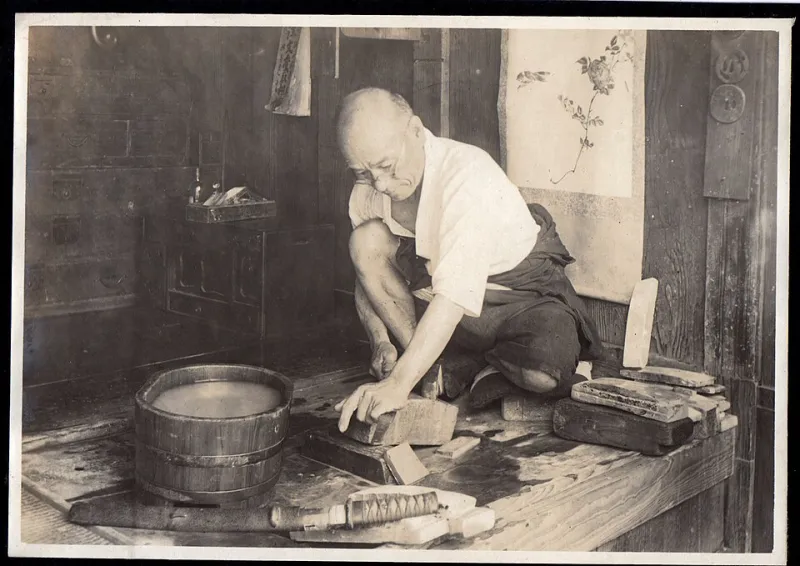
Photo: Elstner Hilton, CC BY 2.0, via Wikimedia Commons
The Workshop Behind the Window
There is a particular kind of quiet that exists in a Ginza artisan's atelier. It is not the silence of emptiness, but the concentrated stillness of someone who has performed the same motion ten thousand times and intends to perform it ten thousand more. On a narrow side street one block east of Chuo-dori — Ginza's main thoroughfare — a fourth-generation leather craftsman named Kenji Mori sits at a workbench his grandfather built in 1952. He is burnishing the edge of a wallet that will retail for over four hundred dollars. The process he is using to finish that single edge will take forty minutes.
"Americans often ask me why the price is so high when the piece looks so simple," Mori says, not looking up from his work. "I tell them: the simplicity is the most expensive part."
This tension between apparent restraint and extraordinary investment sits at the very heart of Ginza's luxury proposition — and it is one that an increasing number of discerning American consumers are beginning to understand, even seek out, in an era when fast fashion has made the concept of quality feel almost abstract.
What Fast Fashion Erased From Our Memory
For much of the past two decades, American retail culture has been shaped by velocity. Trend cycles that once spanned seasons now complete themselves in weeks. The result has been a collective amnesia about what handmade objects actually feel like — not just aesthetically, but in terms of their weight, their smell, the way they respond to use over time.
Ginza's master craftspeople have not participated in this amnesia. They cannot afford to, and more importantly, they have no interest in doing so. The district's artisanal community operates on an entirely different temporal logic, one rooted in the Japanese concept of shokunin — a word that translates loosely as "craftsman" but carries connotations of lifelong devotion, moral seriousness, and the subordination of the self to the perfection of one's work.
Hiroko Tanaka, who has spent thirty-one years weaving textiles for a Ginza atelier that supplies fabric to three of Japan's most respected fashion houses, describes her practice in terms that have nothing to do with trend forecasting. "I think about the person who will wear this in fifteen years," she says. "I think about whether it will still be worth wearing. That is my only deadline."
The Techniques That Justify the Price
For American collectors accustomed to evaluating luxury through the lens of brand heritage or marketing spend, the specific techniques employed in Ginza workshops can initially seem like arcane detail. They are, in fact, the entire argument.
Consider tsutsugaki, a resist-dyeing technique that requires an artisan to apply rice-paste resist by hand through a paper cone before immersing fabric in natural indigo dye. A single scarf produced this way requires three to five days of work, multiple dyeing sessions, and a level of manual control that cannot be replicated mechanically. The resulting piece does not merely look unique — it is unique, carrying within its irregularities a record of the specific hands and specific hours that created it.
Or consider the mizuhiki cord-work incorporated into certain Ginza accessories, a tradition originally associated with formal gift-giving that has been reinterpreted by contemporary designers as a form of wearable sculpture. Each knot in a mizuhiki piece is tied by hand according to patterns that take years to master. The learning curve is so steep that most workshops accept apprentices for a minimum of three years before allowing them to work on pieces intended for sale.
Mori's leather work involves a process called seimenuri, a form of edge finishing using a natural wax compound that he prepares himself from a recipe passed down within his family. "I could buy a commercial edge paint," he acknowledges. "It would take two minutes instead of forty. But the piece would feel different in ten years. It would look different. The customer who understands that difference is my customer."
The American Collector's Awakening
That customer is increasingly American. Over the past several years, a quiet but significant shift has occurred among the upper tier of American fashion consumers — particularly those based in cities like New York, San Francisco, Chicago, and Los Angeles, where exposure to global design culture runs deep. These buyers have begun to move away from the conspicuous signifiers of traditional European luxury and toward objects defined by what might be called earned obscurity: pieces that reveal their value slowly, to those with the knowledge to perceive it.
Several Ginza workshops have reported a marked increase in American clients making the journey to Tokyo specifically to commission custom pieces or visit ateliers in person. For many, the experience of watching a craftsperson work is itself part of the transaction — a form of authentication that no certificate of provenance can fully replace.
"When someone comes here and sits in my workshop for two hours, they understand the price before I tell them," Mori says. "They have seen the hours. They don't need to be convinced."
Rethinking the Luxury Equation
What Ginza's artisanal community ultimately offers is a reorientation of how luxury is calculated. In the dominant Western luxury model, price is justified through brand equity, exclusivity, and the social signaling value of a recognizable name. In the Ginza model, price is justified through time — specifically, the irreplaceable human hours embedded in an object that cannot be manufactured faster without ceasing to be itself.
This is not a sentimental argument. It is an economic one. A piece that takes forty hours to make by a craftsperson with thirty years of expertise represents a genuine scarcity that no supply chain optimization can address. The object is, in a very literal sense, irreproducible at scale. That irreproducibility is the luxury.
For American consumers who have spent years navigating a market flooded with items that look expensive and wear cheaply, the Ginza proposition can feel almost revelatory. It asks for patience, for a willingness to learn, and for a fundamental revision of the question "Is this worth it?" The answer, in these workshops, is always the same: come and watch. Then decide.