One Bag, Three Climates: Styling a Ginza Icon Across Manhattan, Austin, and Seattle
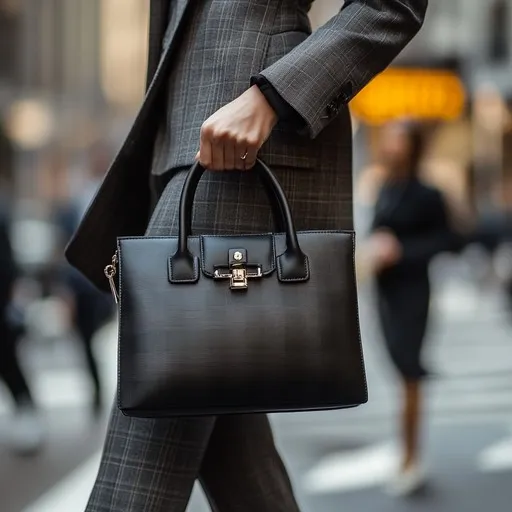
Photo: woman structured leather handbag city street style minimal, via images.stockcake.com
There is a test that every serious accessory must eventually face: not the runway, and not the boutique mirror, but the reality of a life lived across different American cities. A bag that performs beautifully in the controlled climate of Ginza's showrooms must still earn its place on a humid Austin sidewalk, in a Seattle downpour, and on a Manhattan platform at 8:15 on a Monday morning.
We selected one piece — a structured leather top-handle bag from a Tokyo atelier, with clean lines, a detachable shoulder strap, and hardware finished in muted brass — and followed it through three very different American wardrobes. What emerged is less a travelogue than a argument about design: that Japanese restraint is not a limitation but the very quality that allows one object to belong everywhere.
Manhattan: The Architecture of Authority
New York rewards precision. The city's professional uniform — tailored trousers, a fine-gauge knit, a coat with a decisive shoulder — leaves little room for accessories that shout. Here, the bag works as architecture: a single vertical object against a monochrome outfit.
The formula: charcoal wool trousers, an ivory silk blouse, a camel overcoat, and the bag carried by its top handle. Nothing else. The muted brass hardware echoes, quietly, the buttons on the coat.
The color logic is subtractive. New York dressers tend toward black, grey, and camel — a palette the bag's deep oxblood leather punctuates without disrupting. In a city where everyone is moving, an accessory that reads as intentional rather than decorative is the one that gets noticed.
Austin: Softness Without Sloppiness
Austin presents the opposite problem. The heat dissolves the boundaries of formal dressing; linen replaces wool, and the line between polished and relaxed blurs by design. A structured bag might seem like a mismatch — until you understand its role as an anchor.
The formula: a washed poplin dress in sand, leather sandals, and the bag worn crossbody with the strap extended. Add nothing metallic beyond what the bag already carries.
Here the Japanese design principle of wa — harmony through contrast — does the work. The bag's firmness gives shape to an otherwise fluid outfit, the way a single bold brushstroke organizes an empty canvas. Austin's palette of terracotta, sand, and faded denim is warmer than Manhattan's, and the oxblood leather sits comfortably inside it, reading almost southwestern in the light.
Seattle: Weatherproofing as a Design Ethic
Seattle asks the hardest question of any luxury object: can you actually live with it? Months of rain turn delicate accessories into liabilities, and many American wardrobes respond by retreating into nylon and canvas. The Japanese answer is different — choose materials and finishes that were built to endure, then use them without apology.
The formula: a waxed cotton trench in olive, straight-leg denim, a merino crewneck, and the bag carried on the shoulder, tucked slightly under the coat's arm shield.
The full-grain leather, treated at the tannery rather than coated afterward, develops a patina in Pacific Northwest damp rather than damage. Seattle's moody palette of olive, slate, and forest green makes the warm leather tone do quiet work as the outfit's single point of warmth.
Why Japanese Versatility Travels
The through-line in all three cities is not the bag's appearance but its logic. Japanese accessory design begins with the assumption that one object will serve many contexts — a legacy of smaller living spaces and a cultural aversion to excess. Proportions are calibrated to work with both tailoring and denim. Hardware is chosen to flatter multiple palettes. Straps are engineered for transformation, not decoration.
American city living, for all its diversity, shares a common demand: the day does not stop at the office door. The bag that moves from a Manhattan meeting to an Austin dinner to a Seattle weekend without costume change is not a compromise. It is, increasingly, the standard against which everything else is measured.